
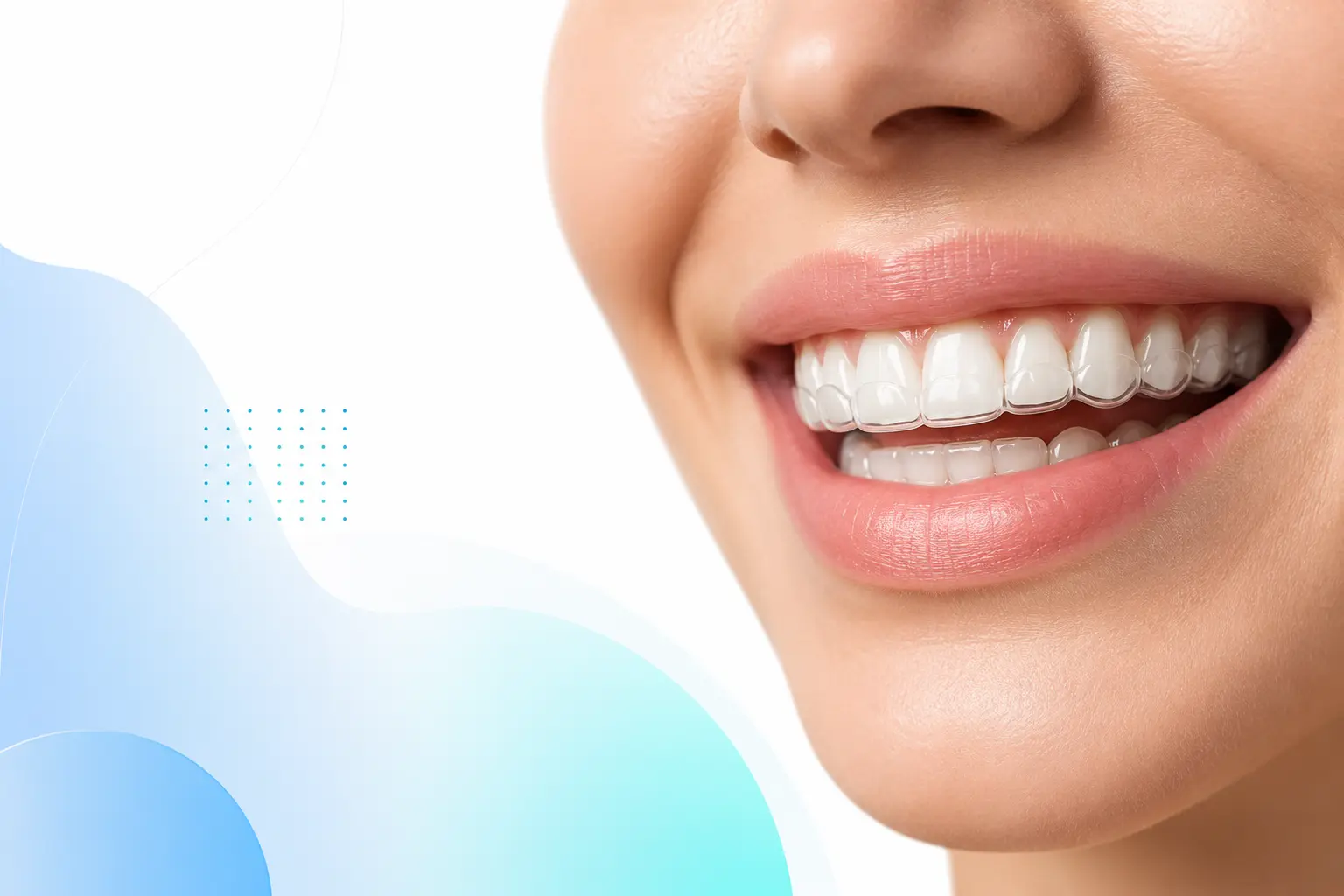
Clear aligner treatment in brief
Orthodontic aligners are a sequence of removable clear trays that guide planned tooth movement. They may be less visually prominent than many fixed appliances, but they require consistent prescribed wear and orthodontic monitoring. Suitability is determined after diagnostics, and active treatment is followed by retention.
Who may seek an assessment
When to discuss clear aligners with an orthodontist
A visible concern, age or preference for a removable appliance does not confirm candidacy.
Tooth position
There is crowding, spacing or concern about the position of individual teeth.
Method comparison
You are comparing clear aligners with braces and want to understand the practical differences.
Previous treatment
Teeth have shifted after earlier orthodontic treatment.
Routine readiness
You are prepared to wear, clean and store the trays as prescribed and attend reviews.
When to visit a dentist
- Teeth appear crowded, spaced or unevenly positioned.
- You have questions about tooth position or bite.
- You want to compare removable aligners with fixed braces.
- Teeth have shifted after previous orthodontic treatment.
- Tooth alignment needs to be considered before restorative care.
- You want to know whether you can follow the required daily routine.
Suitability and preparation
How readiness for treatment is assessed
The orthodontist considers tooth and bite position, planned movements, oral health, required diagnostic records and the patient’s ability to follow the prescribed routine.
Examination and diagnostics
Photos or a description alone are not enough to choose a safe treatment method.
Teeth and gums
Active dental or gum problems may need treatment or stabilization first.
Therapeutic dentistryOral hygiene
Professional cleaning may be advised when indicated, but not every patient needs every preparatory step.
Alternative direction
The assessment may lead to braces, preliminary care or monitoring instead of aligners.
A preparatory stage does not necessarily rule out aligners. Suitability can be reconsidered after oral health is stabilized.
Possible treatment elements
Attachments and additional stages
Attachments are small elements that may be placed on teeth to help a tray deliver a planned movement. They are not required in the same way for every patient.
Attachments
Their need and position depend on the individual plan, and they may be visible at close range.
Additional stages
Further aligners or other orthodontic procedures may sometimes be indicated as treatment progresses.
How treatment works
01
Consultation: the orthodontist discusses concerns, goals and previous dental treatment.
02
Diagnostics: tooth position, bite, oral health and method suitability are assessed.
03
Preparation and planning: active problems are treated when indicated and an individual plan is prepared.
04
Starting treatment: the patient receives the prescribed aligner sequence and instructions for wear and care.
05
Staged wear and reviews: trays are used in the prescribed order while progress and fit are monitored.
06
Completion and retention: after active movement, the orthodontist plans how to maintain the new tooth position.
Daily wear
Removable does not mean optional
Treatment progress partly depends on adherence. The orthodontist defines the wear and stage-change instructions for the individual plan.
Follow the prescription
Wear and reinsert trays according to the orthodontist’s instructions.
Keep the sequence
Do not move independently to a previous or later set.
Clean and store
Care for the trays and keep them as instructed when they are out of the mouth.
Attend monitoring
Reviews assess tray fit, movement progress and oral health.
Limitations
What to consider before choosing aligners
Not suitable for every case
Some clinical situations may require a different orthodontic approach.
Patient responsibility
A removable appliance requires consistent daily wear.
Loss or damage
A tray can be lost, damaged or used incorrectly.
Monitoring remains necessary
Removable treatment is still clinically supervised treatment.
Benefits
- A removable option for suitable clinical cases.
- Open access to tooth surfaces for home cleaning.
- No fixed brackets or wire during meals after trays are removed as instructed.
- Clear trays may be less visually prominent than many fixed systems.
- Staged treatment based on an individual orthodontic plan.
- Regular monitoring by an orthodontist.
Daily routine
Meals, drinks, cleaning and storage
Teeth and aligners need separate care. The clinic should confirm the appropriate products and routine.
Meals
Remove trays for eating as instructed and clean the teeth before reinsertion where possible.
Drinks
Ask the orthodontist how different drinks should be managed during wear.
Cleaning
Avoid aggressive methods that may damage or distort a tray.
Storage
Store removed aligners as instructed to reduce contamination, damage or loss.
If a tray is lost or damaged, keep the available sets and contact the clinic. Do not change stages without instructions.
Duration
What affects treatment length
There is no universal timeline, and an initial estimate is not a guarantee.
Clinical situation
Starting tooth position, bite and movement complexity.
Biological response
Tissues respond to orthodontic movement individually.
Adherence
Inconsistent wear, damaged trays or missed reviews may affect progress.
Additional stages
A further aligner sequence may sometimes be recommended.
Clear aligners or braces
Neither method is universally better. The choice depends on diagnosis, treatment goals, oral health, complexity and adherence.
| Factor | Clear aligners | Braces |
|---|---|---|
| Appliance | Removable clear trays | Fixed appliance |
| Daily discipline | Prescribed wear is essential | Detailed appliance care is essential |
| Cleaning | Trays are removed for tooth cleaning | Cleaning is needed around brackets and wire |
| Meals | Trays are removed as instructed | Care is needed to protect the appliance |
| Visibility | May be less prominent; attachments can be visible | Appliance elements are usually visible |
| Suitability | For suitable cases | May be preferable for some treatment needs |
| Monitoring | Fit and progress reviews | Reviews and adjustments |
The methods are not always interchangeable. Final suitability is determined after diagnostics.
Following recommendations
What can affect planned progress
A deviation does not automatically mean treatment has failed, but it should not be corrected without clinical advice.
Inconsistent wear
A tray may stop matching the actual tooth position.
Poor hygiene
Plaque trapped beneath a tray may affect teeth and gums.
Wrong sequence
Another set may not match the current stage of movement.
Missed monitoring
Fit, progress and oral health cannot be assessed on time.
If assessment is postponed
Is every orthodontic concern urgent?
Not every irregularity requires immediate treatment, and not every concern inevitably worsens.
Hygiene
Tooth position can sometimes make daily cleaning more difficult.
Function
Bite features may matter for chewing or load distribution.
Future planning
Tooth position may influence the sequence of later dental care.
A consultation can clarify whether monitoring, aligners, braces or preliminary care is appropriate and does not commit you to treatment.
After active treatment
Retention after clear aligners
The new tooth position needs support after active movement.
Retainer
The orthodontist selects a retainer or another retention appliance for the clinical situation.
Individual routine
Type, wear, care and monitoring are planned individually.
Maintaining position
Ignoring retention advice may allow movement, while retention cannot guarantee that teeth never change.
Cost
What affects the cost of clear aligner treatment
The current price list includes aligner diagnostics and a full treatment course. Exact inclusions and final cost are clarified after consultation.
Diagnostics
The required diagnostic scope is individualized.
Plan and complexity
Movement complexity and the prescribed aligner sequence affect planning.
Additional stages
Attachments, further trays and replacements require confirmation of whether they are included.
Monitoring and retention
The inclusion of reviews and retention should be confirmed in the individual plan.
Prices
Prices White Rabbit
| Service | Price |
|---|---|
| Standard consultation | 300 UAH |
| Extended consultation | 500 UAH |
| Targeted dental X-ray | 250 UAH |
| OptraGate placement | 250 UAH |
| Rubber dam isolation | 300 UAH |
| Anesthesia | 250 UAH |
| Service | Price |
|---|---|
| Professional oral hygiene | 1900 UAH |
| Children's professional oral hygiene | 950 UAH |
| Teeth whitening course including professional and at-home whitening stages | 13000 UAH |
| Service | Price |
|---|---|
| Superficial caries treatment | 1500 UAH |
| Moderate caries treatment | 1800 UAH |
| Deep caries treatment | 2200 UAH |
| Tooth reinforcement with fiberglass material | 300 UAH |
| Protective liner | 300 UAH |
| Tooth restoration | from 2500 UAH |
| Primary root canal treatment (restoration not included) | 1500–6800 UAH |
| Root canal retreatment (restoration not included) | 2000–8100 UAH |
| Service | Price |
|---|---|
| Zirconia crown | 7900–8900 UAH |
| Ceramic crown or veneer | 8900–10000 UAH |
| Metal-ceramic crown | 4500 UAH |
| Cast metal crown | 2200 UAH |
| Impressions | 1200–2400 UAH |
| Noritake metal-ceramic implant crown | 10600–14700 UAH |
| Zirconia implant crown | 12600–16800 UAH |
| Removable acrylic denture | from 6500 UAH |
| Clasp denture | 12000–22000 UAH |
| Temporary cosmetic denture | 4500 UAH |
| Service | Price |
|---|---|
| Permanent tooth extraction | 950–2000 UAH |
| Wisdom tooth extraction | 2000–4500 UAH |
| MegaGen AnyOne implant placement | 400 USD |
| MegaGen AnyRidge implant placement | 450 USD |
| Straumann Group Neodent implant placement | 450 EUR |
| Service | Price |
|---|---|
| Pre-treatment orthodontic diagnostics | 2000 UAH |
| Braces (Korea), 1 jaw | 15000 UAH |
| Damon Q/Q2 braces (USA), 1 jaw | from 25000 UAH |
| Braces adjustment, 1 jaw | 750 UAH |
| Braces removal, 1 jaw | 1000 UAH |
| Retainer bonding, 1 jaw | 3000 UAH |
| Orthodontic mini-implant | 100 USD |
| Treatment with Trainer, LM-Activator Myobrace, Aquasplint or Aqualizer appliances | 7000 UAH |
| Treatment with a removable plate appliance | 9000 UAH |
| Diagnostics before aligner treatment | 70 EUR |
| Full course of aligner treatment | 2000–3000 EUR |
Related care
Services that may be relevant
Orthodontics
Broader bite assessment and treatment-direction selection.
Go to orthodonticsBraces
A fixed alternative that may be more appropriate after diagnostics.
Compare with bracesConsultation
The first step for assessment and method discussion.
Book a consultationTherapeutic dentistry
Treatment of active dental problems before orthodontic care.
Go to therapeutic careProsthodontics
Coordination when alignment forms part of a restorative plan.
Go to prosthodonticsPrices
Current aligner diagnostic and treatment-course entries.
View pricesHelpful reading
What to read about oral care and retention
Existing guidance on home care and maintaining tooth position after active orthodontic treatment.
Services
Related services
Explore other treatment directions that are often combined with this service or help solve related dental issues.
Orthodontics
Orthodontics in Kharkiv: braces, aligners, plates and an individual treatment plan for children and adults.
Learn moreConsultation
Dentist consultation in Kharkiv with examination, diagnostics, treatment planning and practical recommendations for adults and children.
Learn moreTherapeutic dentistry
Therapeutic dentistry in Kharkiv: treatment of caries, pulpitis, root canal problems and restoration of teeth with fillings and direct restorations.
Learn moreFAQ
Common questions about Clear aligners
What are clear aligners?
They are removable clear orthodontic trays that guide tooth movement through a prescribed sequence. Treatment requires diagnostics, consistent wear and monitoring.
How do I know whether aligners suit me?
An orthodontist determines suitability after examining tooth position, bite, oral health, movement complexity and readiness to follow the routine.
Can adults use clear aligners?
Yes, adult age alone does not rule out treatment. Suitability depends on the clinical situation and oral health.
Are aligners invisible?
No. Clear trays may be less visually prominent than many fixed systems, but they and any attachments can still be visible.
How many hours should I wear them?
The orthodontist prescribes the wear routine for the individual plan. A universal number should not replace clinical instructions.
What if I do not wear them as prescribed?
The tray may stop matching the tooth position and treatment may need more time or adjustment. Contact the orthodontist rather than changing stages yourself.
Do aligners hurt?
Pressure or temporary sensitivity may occur when treatment starts or a new prescribed stage begins. The experience varies, so pain-free treatment cannot be guaranteed.
How often are aligners changed?
The orthodontist defines the sequence and timing. Do not move to another set without approval.
Does everyone need attachments?
No. Attachments are used only when indicated by the individual treatment plan.
Can I eat while wearing aligners?
Trays are removed for meals according to the orthodontist’s advice, and oral hygiene is important before reinsertion.
How should aligners be cleaned?
Use the method and products recommended by the clinic. Aggressive cleaning may damage or distort a tray.
What if a tray is lost or damaged?
Contact the clinic and do not independently switch to a previous or later set. Advice depends on the current stage.
How long does treatment take?
Duration depends on the clinical situation, movement complexity, bite, biological response and adherence. It cannot be guaranteed before diagnostics.
Are aligners faster than braces?
Not necessarily. Duration depends on the treatment needs and adherence, not only on appliance type.
Which is better, aligners or braces?
Neither is universally better. The choice is made after diagnostics according to clinical needs and the patient’s ability to follow recommendations.
What affects the cost?
Diagnostics, complexity, treatment scope, the aligner sequence, additional procedures, monitoring and retention can affect cost. Inclusions are confirmed after consultation.
Can additional aligners be needed?
Further stages may sometimes be recommended as treatment progresses. The orthodontist determines whether they are needed.
Are retainers needed afterwards?
Retention follows active tooth movement. The retainer type, routine and duration are individualized.
When should I book a consultation?
Book if you are considering aligners, comparing them with braces or want to know whether orthodontic treatment is appropriate. Consultation does not commit you to treatment.